Is Claude Text Watermarked? What Actually Shipped vs. What Was Announced
Short answer: as of today, almost certainly not, and Anthropic hasn’t said otherwise.
That’s a more boring answer than the one you probably saw in your feed. It’s also the one the source documents actually support. In the couple of weeks since the announcement, most of the coverage has been reaction, and a fair amount of it collapsed a scheduled rollout into a shipped feature. The real policy is narrower, stranger, and frankly more useful to understand than either the outrage or the applause would have you believe.
Here’s what the primary sources actually say.
What the headlines said
In early August, Anthropic confirmed it would add machine-readable watermarks to text generated by Claude, in order to comply with Article 50 of the EU AI Act. Anthropic has signed the EU’s Code of Practice on Transparency of AI-Generated Content, alongside roughly 190 other organizations. The coverage that followed was broadly accurate about the commitment and broadly vague about the timeline, and the timeline is the entire story.
The framing most people absorbed was “Claude output is now watermarked.” What was actually announced was closer to “Claude output will be watermarked, starting with models that launch from here forward.”
The date gate is the whole thing
Anthropic’s help center article is explicit about scope:
Claude models launched on or after August 2, 2026 support marking at launch.
And, separately, about everything released before that date:
The law includes a transition period for Anthropic models launched before August 2, 2026, and we’re working to add marking support for those models as well.
That’s a launch-date gate, not a switch flipped across the fleet. Marking is applied at the model level, which is why it works consistently across every surface once a model supports it, and why it can’t just be turned on for an existing model without a model-level update.
So the practical question isn’t really “did Anthropic ship watermarking.” It’s “which models have it,” and that question has a short answer right now.
Which models that covers today
Every model currently available to the public predates the August 2 cutoff. Fable 5 and Mythos 5 launched June 9. Sonnet 5 landed June 30. Opus 5 shipped July 24. Haiku 4.5 dates back to October 2025. No new model has launched since August 2, which means the day-one marking clause hasn’t yet had anything to apply to.
Combine that with the backfill being described as “in progress” rather than complete, and you get the current state: no publicly available Claude model has been confirmed by Anthropic to produce watermarked text.
There’s also no way for you to check independently. Anthropic has committed to supporting detection by users and third parties, as the Code of Practice requires, but in the help center article the mechanisms are described as “forthcoming technical documentation.” Nothing has been published. The technical explainer says a watermark detection API is coming, and that the details of its implementation are still being worked out. Any tool currently claiming to detect a Claude watermark is not working from a published spec.
Two different mechanisms, constantly conflated
A lot of the confusion in the coverage comes from treating this as one feature. It’s two, and they behave differently.
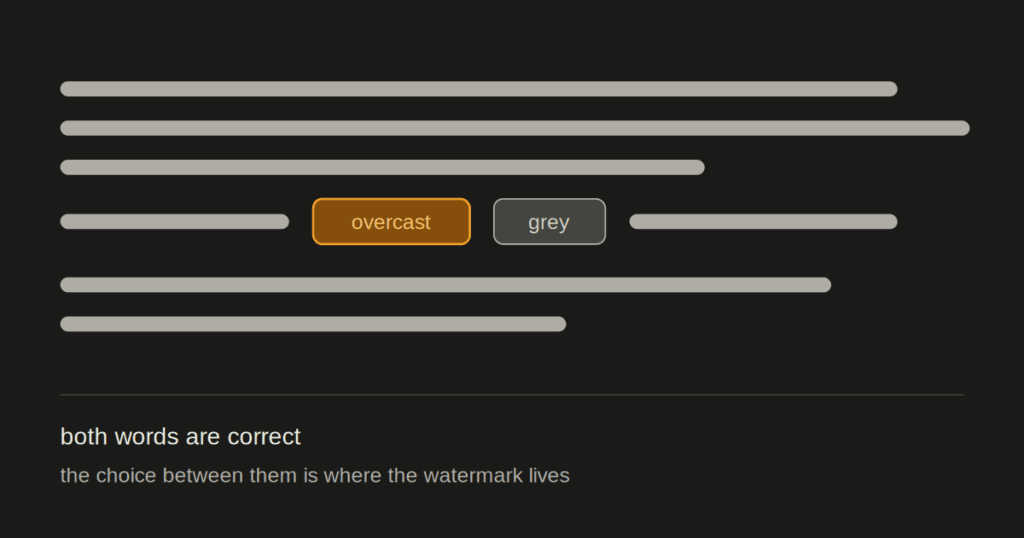
Embedded text watermarks. When a supported model generates text, the watermark is woven into the generation itself. Anthropic’s technical explainer describes it as a pattern formed through low-stakes word choices, the kind of decision between “overcast” and “grey” where either word is equally correct. The claims are specific: nothing is added to the text, there are no hidden characters, no extra tokens are consumed, and it carries no information traceable to a person, organization, or conversation. Because the mark lives in the word choices themselves, it survives copy and paste and may persist through some editing. The underlying technique is a version of SynthID-Text, the scheme Google DeepMind published in Nature in 2024 and has been running in production on Gemini.
Signed provenance metadata. For supported file types such as .svg, .png, and .jpg, Claude attaches metadata following the C2PA standard. This is ordinary file metadata. It travels with the file, it signals that the file was processed by Claude, and it lets you detect tampering.
The distinction matters operationally because the second one is trivially removable and the first one is not. Any format conversion, re-save, screenshot, or metadata strip drops C2PA. If your pipeline runs images through a converter or strips metadata before publishing, provenance is already gone, and it was gone before any of this was announced.
The global rollout is the genuinely notable decision
Nothing in an EU code of practice requires marking content generated for a user in Pennsylvania. Anthropic applied it worldwide anyway, “wherever Claude is offered.” In their words, they’re “applying watermarking globally at launch because we don’t yet have a durable way to scope it by region.”
You can read that as principled consistency, or as the cheaper option than maintaining two inference paths. Either way the practical result is identical: there’s no region you can route through to get unmarked output, and there’s no consumer toggle. This is the part of the announcement that deserved more attention than it got.
What Anthropic says its own marks cannot tell you
The limitations section of the support article is unusually candid, and it undercuts most of the use cases people immediately imagined.
A detected mark does not establish authorship. People use Claude to proofread, translate, summarize, and convert files. Output can carry a mark even when the underlying ideas, text, and data came from somewhere else entirely. A mark means the content may have been processed by Claude, a much weaker claim than “an AI wrote this.”
No detected mark does not mean a human wrote it. Anthropic lists five ways marked content loses its mark: generation by a pre-marking model, heavy editing or paraphrasing or translation, passages too short to carry a reliable signal, metadata stripped through conversion or re-saving, and platforms or file types where a marking type isn’t supported. The technical explainer is similarly blunt: light editing probably won’t strip the watermark completely, but “a complete rewrite where every word is replaced will.”
Read those two together and the honest summary is that this is a probabilistic signal about processing, not a proof of authorship. Anyone planning to use it as evidence in an academic integrity case or a contractor dispute is going to have a bad time.
What this actually means if you publish
If you use Claude in a content workflow, three things follow.
Nothing about your current output has changed. Text you generated last week isn’t marked, and text you generate today almost certainly isn’t either.
The change will arrive silently. Because marking is model-level, it comes with a model update rather than a release note in your dashboard or a settings toggle you’d notice. There’s no notification surface for this. The support article is the announcement channel.
Heavy editing degrades the signal, and Anthropic says so. This is stated as a limitation of the system, not as a workaround. But it does mean a workflow where a draft is substantially rewritten, restructured, and layered with original material behaves differently from one where output is published close to as-generated. That’s worth knowing regardless of how you feel about the policy.
What to watch
The single page worth checking periodically is Anthropic’s help center article on how Claude marks AI-generated content. Two things will appear there before anywhere else: the model list, when backfill completes, and the detection documentation, when it’s published.
The second one is the more interesting release. A watermark nobody can check is a compliance artifact. A watermark with published detection is an actual signal, and it will immediately be used for things Anthropic’s own limitations section says it cannot reliably support.
Sources: Anthropic help center, “How Claude marks AI-generated content”; Anthropic, “How Claude’s text watermark works”; European Commission, “Strong backing for the Code of Practice on Transparency of AI-generated Content”; Dathathri et al., “Scalable watermarking for identifying large language model outputs,” Nature (2024). All accessed August 22, 2026.